Numerous Models Worldwide Make Different Projections About the Coronavirus Spread
- Covid-19
-
 Uncoverstory .
 - May 4th 2020
Pandemic tends to stir things up. Just a matter of a month back, when the weather app in our phones was in rampant use. A large majority of the people would open up the app quite frequently, to check on weather updates. And all those who happen to open the app almost regularly would admit of accepting that the weather prediction can get wrong at times.
That said, in the present time, when the entire world has fallen into the throes of COVID-19, it is possible to keep track of the coronavirus models several times during the day. And quite a few of them change as quickly as the weather.
For those who wish to get ahead of the curve, you must be looking through a mathematical and statistical model of some sort. These models are new ways of discovering the answers to questions you would never be willing to learn the tough way.
As with the novel coronavirus or any similar contagion, models can vary from being straightforward to complicated. The most uncomplicated projection for SARS-COV-2 would put the 1927 classic model to use, termed as Kermack and McKendrick (named after its developers). With the virus being this deadly, what amount of people is expected to be infected if we put no effort to get in its way? If you do the basic math, the answer would roughly come to 89%-that amounts to 290 million Americans.
How many of the people would be impacted by serious disease? We are still on our way to discover that. The statistical way of estimating the percentage of infected people, who are likely to die from this deadly virus is difficult. For instance, if we monitor only serious cases that are taking place in hospitals, the mortality will look higher than usual.
If we happen to do our calculation too early, then we wouldn’t be counting some people who are yet to lose their lives and there will be an underestimation of the overall mortality. So it is difficult to learn the correct answer until in the later stages of the pandemic. The hopeful projections are at 0.6%, implying that about 6 in 1000 people will die. However, in the most randomly optimistic assumption that the rate of mortality for COVID-19 is the same as that of the flue, which kills 1 out of 1000 infected people, that would imply more than 290,000 deaths only in the United States.
Still, models are not the future, and that mere model makes a large number of faulty presumption-with the inclusion of humans moving around and randomly contacting each other, like the molecules present in the gas, rather than making nonrandom contacts with specific networks, as we normally do. You are likely to contact a particular bunch of folks in your local community, be it at your workplace, house, or local community. This doesn’t indicate that the model is incorrect, it just implies that to seize physical distancing, you must make it more complex.
Various teams are working day in and day out to involve some of these complexities. One model series at the Imperial College London estimates the possible effects of different amounts of social distancing, which briefs you on the number of lives that are expected to save, with several forms of restrictions.
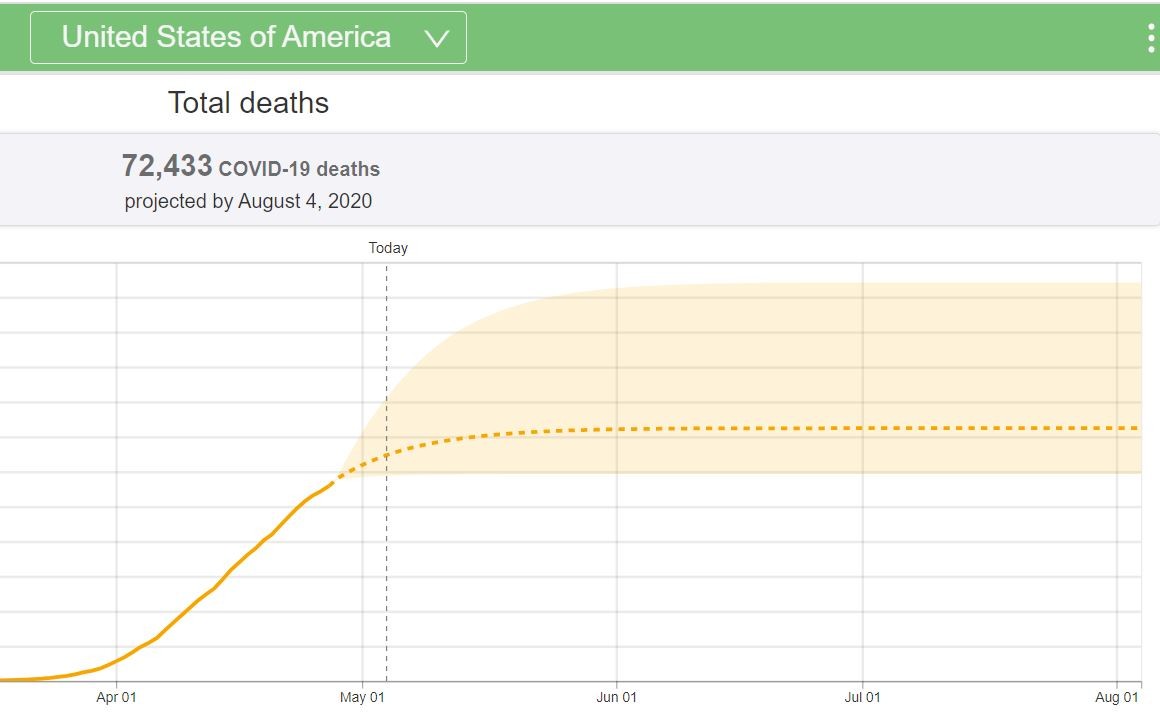
The trending model getting the most attention in the States, from the White House and news media alike is a different beast altogether. Thanks to the communicative website and regularly updated figures for different states that estimate the time to the health care systems’ peak strain, the IHME or Health Metrics and Evaluation has made a giant impact. The IHME model makes dramatically different estimates of the total disease burden and pandemic death than the IC model.
The IHME model is not a model of infectious disease, as it doesn’t involve human transmission. It just assumes that the new infections build and then fade away. It doesn’t even model the physical distancing process that is supposed to make them fade. The IHME model is a statistical model that puts death to the curve, and the IC model is a mechanistic model in which the case numbers go up and come down for a reason, and the way they go up and the way they come down depends upon the parameters fed to the model.
While epidemiology can be complex, it can get simple as well. Talking about the advantages of various models instead of adopting quicker actions to slow down the unabated spread of the coronavirus is a grave mistake. The model would serve as a great role in plotting future strategies after we successfully emerge as warriors from this crisis phase, and we would be enlightened with better data to intimidate them. However, for the upcoming weeks and months, our responsibility is to stop the advancement and development of those grim data points.















Leave a Reply